

Making a Fire Poker from Reclaimed Steel
Why Reclaimed Steel Makes a Fine Poker
A fire poker is one of the best first projects for a smith, and it is even better when the steel comes from something already lying about. Old rail spikes, lengths of gate rod, worn-out coil spring, a bent tie bar from a shed — all of it will do the job. The steel is usually a plain mild or low-carbon sort, which moves sweetly under the hammer and forgives a beginner's mistakes. Spring steel fights you a bit more, but holds a fine, springy point.
There are two things to avoid. Never forge anything galvanised — the zinc coating gives off fumes that will make you properly ill, and it spits in the fire. Painted stock is best cleaned up with a grinder or burnt off outdoors first. Anything you cannot identify is fine for a poker, so long as you treat it kindly and do not quench it from a bright heat on the off-chance it is air-hardening.
Size matters more than you would think. A fire poker wants to finish somewhere around 60–70cm long. Drawing out stretches the metal considerably, so start with a bar roughly 45–50cm of 10–12mm round or square stock, and you will end up in the right place.
The Fire, the Tools, and Reading the Heat
You need very little: a forge, an anvil or a length of rail set in a stump, a hammer around 800g to 1kg, tongs that fit your stock, a wire brush, and a bucket of water for quenching and cooling your tongs. Coke or charcoal both work well in a solid-fuel forge; a gas forge is quicker to light and easier to control.
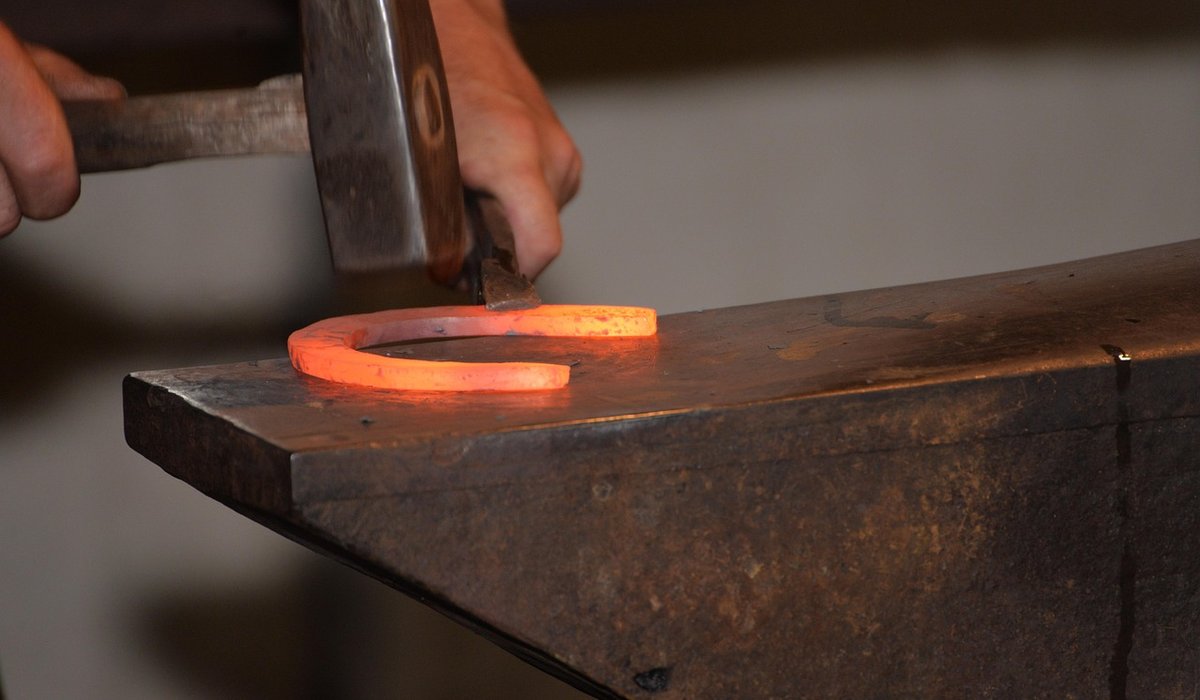
Bring the steel to a bright orange, roughly 1,100°C. Learning the colours is the single most useful skill in the craft:
- Dull red (about 600°C) — too cold to move properly.
- Cherry red (around 700–800°C) — workable, but hard going.
- Bright orange (1,000–1,100°C) — ideal for drawing out and bending.
- Yellow (1,200°C) — hot enough to burn the steel if you linger. Watch for sparks.
Never hammer below a dull cherry red. Cold steel tears and cracks along the edges, and you will spend the rest of the day chasing splits. Reheat often; it costs nothing but time.
Drawing Out the Shaft
Take a comfortable grip with your tongs and bring the middle of the bar to a bright orange. Lay the hot section across the anvil with the metal overhanging the far edge, and strike with the face of the hammer, pushing the steel lengthways rather than squashing it flat. Let the hammer do the work — a loose, shoulder-driven swing beats a squeezed, white-knuckled one every time.
Rotate the bar a quarter turn between blows. This keeps the section even instead of turning it into a flat ribbon, and it is the small habit that separates tidy work from something that looks chewed. Work one short section of 5–8cm at a time, then advance along the bar, reheating as the colour drops.
Stop every few heats and sight down the length of the poker with one eye closed. It will have wandered. Straighten it over the anvil while it is still hot, and you will save yourself an awkward job at the end.
For the last 10cm or so, taper the shaft gradually to a point. A long, gentle taper looks purposeful and slides between coals nicely; a stubby one just looks like you ran out of patience.
Forming the Point or Hook
There are two schools of thought here. A tapered point is best for stabbing and lifting, while a right-angled hook is better for raking ash and dragging logs forward. You can have both: draw out a point, then bend the last 5cm through 90 degrees with a slight upward sweep.
To make the bend, heat a 10cm length evenly, lay it over the horn of the anvil or grip it in a vice, and pull steadily. A slow, controlled pull gives a clean curve; a sudden yank gives you a kink and a dent.
A Handle Worth Holding
This is where a poker stops being a rod and starts being a tool. The classic treatment is a twist. Heat 12–15cm of the handle end to an even orange, clamp one end in the vice, and twist the other with tongs or a pipe wrench. Six to eight turns gives a well-defined spiral. Work briskly and keep the heat uniform across the whole section — twist while one end is hotter than the other and the spiral will wander thin on one side.
Then finish the very end. A small scroll curled over the horn, a loose loop, or a flattened, tapered grip all work. A punched hole at the tip, drifted round while hot, takes a leather thong so the poker can hang on a nail beside the hearth — a small detail that makes it feel finished.
Finally, tidy up with a file or grinder, taking the sharp flash off the edges where your hand will sit.
Finishing and Putting It to Work
Brush the hot steel with a wire brush to shift the loose scale, then bring it back to a black heat — around 200–250°C, when it is just too hot to touch — and rub in beeswax or linseed oil. This gives a deep, matt black finish that shrugs off damp. Do not paint or varnish it; the coating will stink and flake the first time it goes near a fire.
Use it as a poker, not a crowbar. A fine point will bend if you lever heavy logs with it, but a bend is easily cured — heat the spot, straighten it, and carry on. Re-oil it once a year, or whenever it starts looking dry, and it will outlast several fireplaces.


Forging Basics
-
Weight, rebound, and condition affect your work. Find out what to look for in a used anvil and how to test it.

Projects


-

Long established fact that a reader will be distracted
-

Long established fact that a reader will be distracted
-

Long established fact that a reader will be distracted

Tooling
Karla Gleichauf
12 May 2017 at 05:28 pm
On the other hand, we denounce with righteous indignation and dislike men who are so beguiled and demoralized by the charms of pleasure of the moment
M Shyamalan
12 May 2017 at 05:28 pm
On the other hand, we denounce with righteous indignation and dislike men who are so beguiled and demoralized by the charms of pleasure of the moment
Liz Montano
12 May 2017 at 05:28 pm
On the other hand, we denounce with righteous indignation and dislike men who are so beguiled and demoralized by the charms of pleasure of the moment